The workshop
Two people, one workshop, no batch runs.
Toyokra started in 2019 when Lena wanted to make a toy for her nephew and couldn't find a single piece she would be happy giving him. Rasmus joined six months later. The workshop has been in the same rented space in Lübeck's Moisling district since 2020.
How the workshop operates
We take custom orders, run evening workshops for small groups, and occasionally have ready-made pieces available. That's it. We don't wholesale to shops, we don't do corporate gift orders, and we don't make anything in quantity.
The reason isn't ideology. It's that making things well takes more time than batch production allows. A single stacking set takes two full days from timber selection to finishing. If we tried to make them in runs of fifty, the quality would change — and not in a direction we'd be comfortable with.
Every piece that leaves this workshop has a maker's stamp on the underside. It's a small carved mark, not a brand logo. It means: someone made this, and that someone can be asked about it.
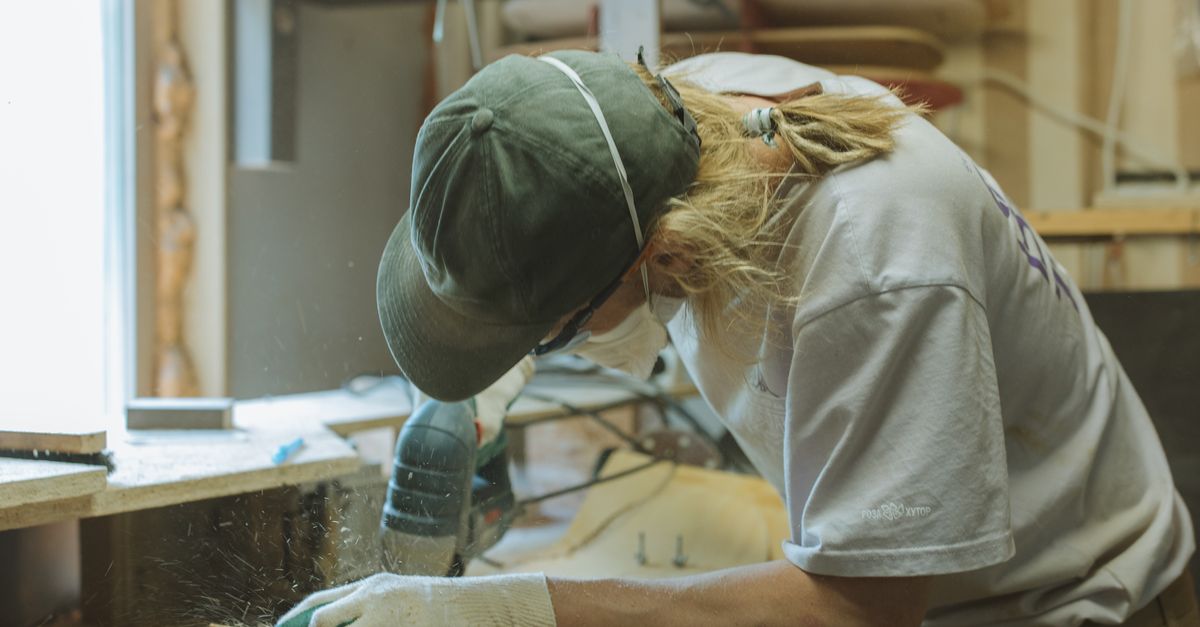
The people behind it.
Co-founder
Lena Böhm
Lena trained as a cabinet-maker in Hamburg before spending five years restoring historical furniture for a museum conservation department in Bremen. She left that work to focus on making new things rather than preserving old ones. She handles material selection, finishing, and most of the custom order shaping work.
She writes most of the Notes on this site, usually about material choices and finishing decisions. Her LinkedIn: linkedin.com/in/lena-bohm
Co-founder
Rasmus Lind
Rasmus grew up in Malmö, where his grandfather ran a small furniture workshop. He studied industrial design in Gothenburg but worked primarily with hand tools rather than the digital fabrication the course was moving towards. He joined Toyokra in early 2020 and runs the workshop sessions and most of the structural joinery work.
His Notes tend towards process — what happens in the workshop from timber arrival to dispatch. LinkedIn: linkedin.com/in/rasmus-lind
The timber we use.
European beech — Fagus sylvatica
The most common wood in our workshop. Hard, close-grained, and almost impossible to splinter under normal play conditions. It takes oil and wax finishes well and ages to a warm honey colour. We use beech for anything that will be gripped repeatedly — stacking pieces, pull-along handles, puzzle shapes.
Source: certified forestry operations in Bavaria and Lower Saxony.
European ash — Fraxinus excelsior
Lighter than beech but with longer, more flexible grain — useful when a piece has protruding elements that need to absorb impact without cracking. We use ash for wheels, axles, and the structural frames of larger pieces. Slightly more open grain than beech, which means it takes pigment a little differently.
Source: Schleswig-Holstein and southern Scandinavia.
Rock maple — Acer saccharum
We use maple less frequently, usually when a piece requires very even colour across a large surface — alphabet blocks, for instance, where visual consistency matters. It machines cleanly and takes water-based pigments with excellent uniformity. It's also the most expensive of the three, which is why it stays reserved for specific applications.
Source: imported through a certified Nordic importer in Hamburg.
Want to visit the workshop?
We occasionally allow visits for people who are considering a custom order and want to see the space. Get in touch first.
Reach us